
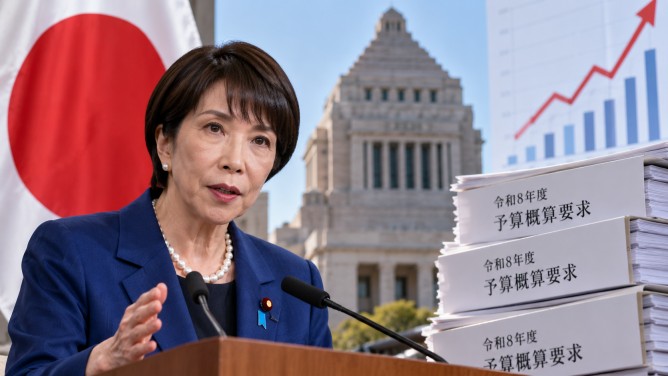
Japan’s upcoming fiscal year budget requests have reached an impressive 143.1 trillion yen, equivalent to $917.8 billion. This figure approaches the high spending levels observed during the COVID-19 pandemic. The increase is largely driven by Prime Minister Sanae Takaichi’s commitment to an expansionary fiscal policy aimed at bolstering investment in key sectors such as artificial intelligence, semiconductors, and economic security.
Within these budgetary submissions, a new strategic investment program accounts for 12.2 trillion yen alone. Meanwhile, potential increases in defense spending loom on the horizon as the government reassesses its defense strategy, with several requested items yet to have defined financial allocations. The rising cost of borrowing is adding further strain to Japan’s financial situation, as the Finance Ministry has adjusted its assumed interest rate from 3.0% to 3.8%, a move prompted by the 10-year government bond yield climbing to 3%, a peak not seen since 1996.
Consequently, the requests for debt-servicing costs, which encompass interest payments and debt redemption, have surged to a record 36.64 trillion yen. This marks an increase of 5.36 trillion yen compared to the current fiscal year. As the government prepares for the fiscal 2027 budget, there is an expectation of intense scrutiny regarding the scale of new government bond issuance. Prime Minister Takaichi has expressed a goal to limit new bond issuance to around 40 trillion yen, while simultaneously striving to decrease the debt-to-GDP ratio.
The government now confronts the challenge of striking a balance between enhancing investment in growth-oriented sectors and adhering to fiscal discipline. This task is made more difficult by the rising interest rates, which elevate the costs associated with servicing Japan’s substantial public debt. As these financial pressures mount, the administration’s ability to navigate this complex fiscal landscape will be closely watched both domestically and internationally.