
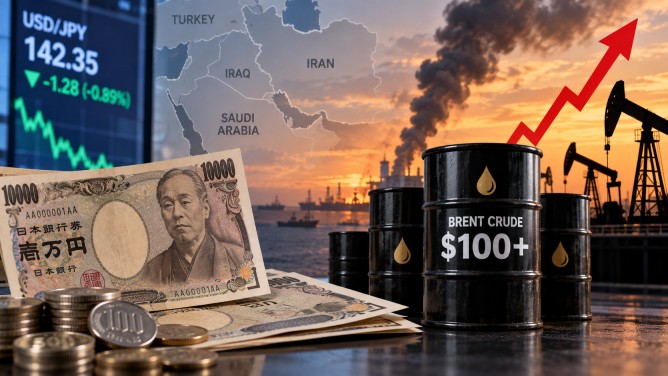
The Japanese yen experienced a surge, reaching a seven-month peak against the US dollar on Wednesday. This development follows renewed unrest in the Middle East, which has caused oil prices to soar past $100 per barrel, consequently heightening inflation worries. The yen’s value was hovering around 153.32 per dollar, nearing Tuesday’s seven-month high of 152.89. This month, the currency has appreciated by roughly 4%, buoyed by the anticipation of further interest rate hikes from the Bank of Japan and the possible repatriation of overseas investments by Japanese investors.
Brent crude futures saw a significant escalation, jumping as much as 2.3% and crossing the $100 per barrel threshold for the first time since late July. This price increase is attributed to escalating military tensions in the Middle East, involving nations such as Saudi Arabia, Iran, and US forces. The climb in oil prices has sparked fresh concerns that renewed energy inflation could complicate the monetary policy decisions facing major central banks. Investors are particularly focused on the upcoming US inflation data, expected on Friday, which might shape the Federal Reserve’s forthcoming interest-rate strategies.
Market analysts are largely anticipating that the Bank of Japan will proceed with a 25 basis point increase in its benchmark rate during the meeting scheduled for September 17-18. The yen’s recent upward trajectory could gain further momentum if Governor Kazuo Ueda indicates a more assertive stance on monetary tightening. Meanwhile, the US dollar saw a modest decline, while the euro appreciated by 0.18%, reaching $1.1641. The dollar index also neared its lowest point in almost two weeks.
Despite the burgeoning trade tensions with the United States, the Canadian dollar has remained relatively stable. In contrast, China’s yuan has maintained its position near a three-and-a-half-year high against the dollar, supported by robust economic data. With oil prices maintaining levels above $100 and critical central bank meetings on the horizon, currency markets are poised to remain highly responsive to developments in the Middle East, inflation statistics, and shifts in interest-rate expectations.