
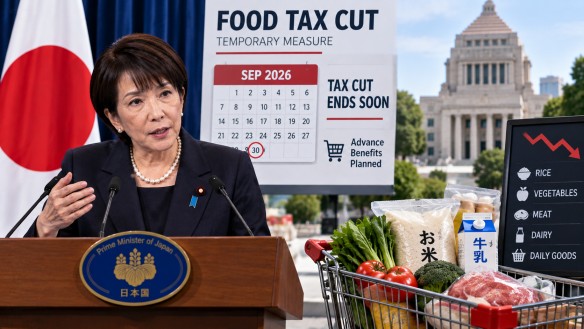
Japan is looking to ease the financial burden on low- and middle-income households as it prepares for a scheduled expiration of a temporary food consumption tax cut in 2029. The government plans to offer advance cash benefits to these households to cushion the impact of the tax returning to its original rate. From April 2027, the tax on food will be temporarily reduced from 8% to 1% for two years. As this period ends in April 2029, the government intends to preemptively distribute half of the annual benefit to eligible households.
Under the proposed measure, the income-based benefit program is set to commence in April 2027. The payments will vary based on the recipients’ income levels and the number of children in each household, with an estimated annual disbursement of around ¥600 billion ($4 billion) for the fiscal years 2027 and 2028. This strategic move is designed to mitigate the financial strain expected when the consumption tax reverts to 8%.
The Japanese government aims to finalize the details of this policy by September, with a plan to introduce the necessary legislation during an extraordinary parliamentary session anticipated in October. To fund this initiative, the government is exploring options such as reviewing existing subsidies, special tax measures, and government spending, all while avoiding the issuance of deficit-financing bonds. However, the exact funding sources remain to be determined.
Apart from assisting households, the government is also setting its sights on supporting sectors like agriculture, forestry, fisheries, and restaurants, which could be affected by these tax changes. Retailers will be granted additional time to adapt to tax-inclusive price display requirements, ensuring a smoother transition as the policy unfolds.