
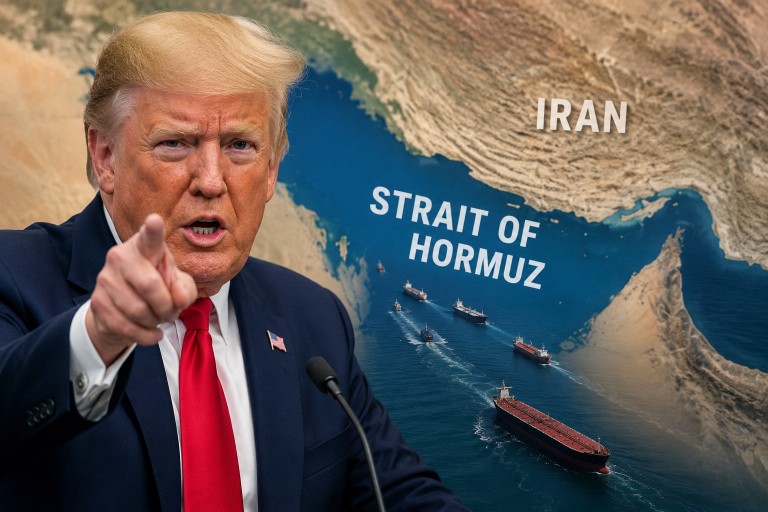
In a bold statement, US President Donald Trump has indicated plans to declare the Strait of Hormuz as “a territory of the United States.” This announcement comes amid ongoing tensions between Washington and Tehran, as both nations struggle to find a diplomatic solution to their conflict. Speaking in New York, Trump asserted that the United States would make this declaration “pretty soon” following a victory over Iran, and claimed that the US already exerts control over the waterway through a blockade.
The Strait of Hormuz holds significant strategic importance as a critical shipping lane, with approximately 20% of the world’s seaborne oil passing through it. Situated between Iran and Oman, the strait has seen restricted passage since US and Israeli military actions commenced against Iran. However, it remains uncertain whether Trump’s remarks signal an official shift in US policy or are merely a rhetorical stance.
Iran has been quick to dismiss these threats. Kazem Gharibabadi, Iran’s Deputy Foreign Minister, stated that Tehran would not succumb to US pressure, emphasizing that decisions regarding the strait’s status rest with Iran. Furthermore, Iranian Foreign Minister Abbas Araqchi highlighted that Tehran has yet to decide on resuming talks with Washington, noting that communications through intermediaries like Qatar and Pakistan do not equate to formal negotiations.
Before allowing the resumption of shipping activities through the strait, Iran has stipulated several conditions, including reparations for damages incurred during the conflict, the lifting of economic sanctions, and the unfreezing of Iranian assets. The ongoing conflict and subsequent disruptions to shipping routes have contributed to rising fuel costs, impacting consumers worldwide. President Trump has defended these price hikes, arguing that the increased costs are a necessary measure to prevent Iran from developing nuclear weapons.
The prolonged impasse over the Strait of Hormuz raises significant concerns regarding global energy supplies, with potential repercussions for the broader economy. As the situation remains tense, the international community watches closely, wary of the escalating stakes in this critical region.