
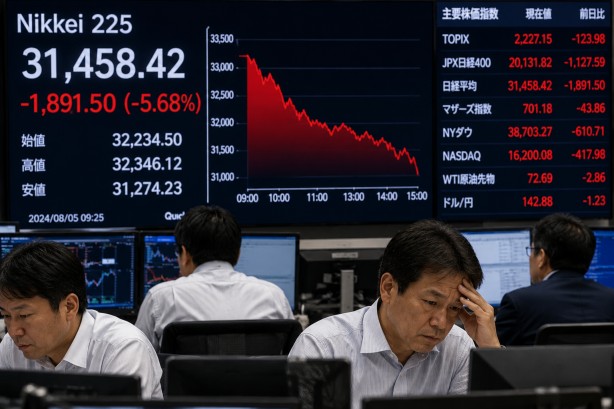
Asian stock markets experienced a significant downturn on Friday, with Japan’s Nikkei 225 index leading the losses due to substantial selling in technology and artificial intelligence-related shares. The Nikkei dropped by 5.8%, closing under the 63,000 threshold. Similar declines were observed across the region, with Taiwan’s market shrinking by over 5%, Hong Kong’s Hang Seng index decreasing by 2%, and China’s Shanghai Composite slipping 1.6%. Australia’s S&P/ASX 200 also fell, though less severely, by 0.7%.
The technology sector has come under increasing scrutiny recently, as investors grow wary of the rapid rise in valuations within the artificial intelligence industry. There is growing skepticism about whether the demand for advanced chips and memory products will remain robust if AI technologies do not deliver the anticipated profits and efficiency improvements. This caution has contributed to the broader market sell-off.
In the United States, the Nasdaq Composite saw a decline of 1.5% on Thursday, primarily impacted by losses in key semiconductor companies. Notably, Nvidia’s shares fell by 2.4%, while Micron Technology, SanDisk, and Western Digital also experienced notable downturns. The performance of these tech giants reflects the broader hesitance among investors regarding the future profitability of AI-driven innovations.
While stock markets faced turbulence, oil prices moved in the opposite direction, rising amid escalating tensions in the Middle East. The situation has sparked concerns about potential disruptions to global energy supplies, particularly through the vital Strait of Hormuz. As a result, Brent crude prices increased by 1.1%, reaching $85.13 per barrel, while the US benchmark crude rose by 1.3% to $79.95 per barrel.