
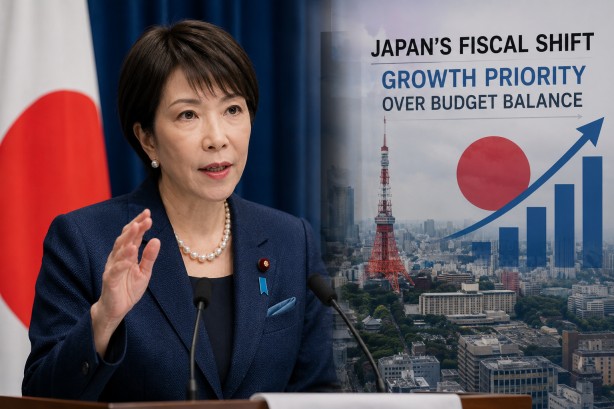
In a notable departure from its traditional emphasis on fiscal consolidation, Japan’s government has endorsed a new economic policy designed to shift priorities under the leadership of Prime Minister Sanae Takaichi. The revised strategy emphasizes fostering economic growth and ensuring long-term fiscal sustainability over achieving a single-year primary budget surplus. This change signals a significant realignment of Japan’s economic objectives.
The core of the government’s new policy aims at progressively lowering the public debt-to-GDP ratio. This goal is underpinned by an ambitious plan to stimulate more than ¥370 trillion in both public and private investments across key strategic sectors, such as artificial intelligence, by the year 2040. The approach reflects a forward-looking vision, seeking to integrate technological advancements into the economic framework.
In addition to investment strategies, the policy encompasses proposals for temporary reductions in food consumption taxes and an increase in defense spending. Such measures have prompted discussions about their financial feasibility and potential impact on Japan’s economy. Economists express caution, noting that the success of the strategy largely hinges on maintaining steady economic growth and favorable interest rates, both of which are uncertain variables in the current global economic climate.
As Japan moves forward with this new economic direction, financial markets are poised to scrutinize the government’s forthcoming budget decisions. Investors and analysts are eager to evaluate whether the proposed spending plans can be aligned with the overarching goal of long-term fiscal stability. The outcome of these decisions will likely have significant implications for Japan’s economic trajectory and its ability to balance ambitious growth targets with fiscal responsibility.